

Finding the right synonym for threaten depends on what you actually mean. You might be describing a direct threat, warning someone about a possible consequence, creating fear, applying pressure, or simply describing something dangerous. Words such as intimidate, menace, warn, coerce, frighten, endanger, and pressure can work in different situations, but they are not always interchangeable.
Choosing the right alternative also depends on tone. A word that sounds natural in everyday conversation may feel too aggressive in a business email or too informal in academic writing. This guide explains the most useful alternatives to threaten, including their meanings, differences, examples, tone, and best uses.
Quick Answer: What Are Synonyms for Threaten?
Common synonyms for threaten include warn, intimidate, menace, coerce, frighten, scare, pressure, bully, endanger, jeopardize, and caution. The best choice depends on context. Use warn for a possible consequence, intimidate for creating fear, and coerce when someone is pressured into doing something.
Quick List of Synonyms for Threaten:
Closest Synonyms for Threaten
- Intimidate
- Menace
- Warn
- Coerce
- Frighten
- Scare
- Bully
- Pressure
- Caution
- Forewarn
Formal Alternatives
- Endanger
- Jeopardize
- Imperil
- Menace
- Coerce
- Impose a threat
- Pose a danger
- Present a risk
- Signal danger
- Put at risk
Neutral Alternatives
- Warn
- Raise a concern
- Indicate a risk
- Create a risk
- Pose a danger
- Signal a consequence
- Put pressure on
- Express a warning
Casual Alternatives
- Scare
- Frighten
- Bully
- Talk tough
- Push around
- Try to scare
Formal Synonyms for Threaten:

Formal alternatives are useful when writing reports, policies, academic work, professional documents, or serious communications. However, some describe a different type of threat rather than being exact replacements.
Intimidate
Meaning: To make someone afraid, especially to influence their behavior.
Explanation: Intimidate focuses on creating fear or making someone feel less confident. It does not always involve an explicit statement of harm.
Example: The manager refused to let an aggressive employee intimidate the new staff.
Best Use: Professional, academic, and descriptive writing.
Worst Use: Avoid it when you simply mean giving someone information about a possible consequence.
Tone: Serious and direct.
Menace
Meaning: To threaten, endanger, or represent a serious danger.
Explanation: Menace is a strong word and can describe either a person or a situation that creates danger.
Example: The abandoned building continued to menace nearby residents.
Best Use: Formal descriptions of serious danger or threatening behavior.
Worst Use: It can sound dramatic in ordinary workplace communication.
Tone: Strong and serious.
Coerce
Meaning: To force someone to do something through pressure, threats, or intimidation.
Explanation: Coerce is narrower than threaten because it focuses on forcing a person into an action.
Example: The employee claimed that he was coerced into signing the agreement.
Best Use: Legal, formal, and professional contexts.
Worst Use: Do not use it simply because someone issued a warning.
Tone: Formal and serious.
Caution
Meaning: To advise someone about a possible danger or problem.
Explanation: Caution is generally less aggressive than threaten. It communicates concern or risk rather than an intention to cause harm.
Example: The engineer cautioned the team about the unstable structure.
Best Use: Safety notices, reports, professional communication, and advice.
Worst Use: It is inaccurate when someone is deliberately threatening another person.
Tone: Neutral and responsible.
Forewarn
Meaning: To warn someone in advance about a possible problem or danger.
Explanation: Forewarn emphasizes timing. The warning happens before the expected event.
Example: The residents were forewarned about the approaching storm.
Best Use: Formal writing, reports, and informational communication.
Worst Use: Avoid it when no advance warning is involved.
Tone: Formal.
Endanger
Meaning: To put someone or something at risk.
Explanation: Endanger describes creating danger rather than making a direct verbal threat.
Example: Reckless driving can endanger other road users.
Best Use: Safety, environmental, workplace, and formal writing.
Worst Use: Do not use it when someone merely says something threatening without creating actual risk.
Tone: Serious and objective.
Jeopardize
Meaning: To put something important at risk.
Explanation: Jeopardize often refers to plans, opportunities, relationships, safety, or success rather than direct personal threats.
Example: Missing the deadline could jeopardize the entire project.
Best Use: Business, academic, and professional writing.
Worst Use: It does not normally replace threaten when describing a person making a threat.
Tone: Formal and analytical.
Imperil
Meaning: To place someone or something in serious danger.
Explanation: Imperil is a formal word that emphasizes serious risk.
Example: The decision could imperil the company’s financial stability.
Best Use: Formal reports, journalism, and serious analysis.
Worst Use: It may sound unnecessarily grand in everyday conversation.
Tone: Very formal.
Pose a Danger
Meaning: To create or represent a potential danger.
Explanation: This phrase is useful when the focus is on risk rather than deliberate threatening behavior.
Example: The damaged electrical system poses a danger to employees.
Best Use: Safety notices, reports, and professional communication.
Worst Use: It does not mean that someone intentionally threatened another person.
Tone: Neutral and professional.
Put at Risk
Meaning: To expose someone or something to possible harm or loss.
Explanation: This expression is broader than threaten and works well when describing consequences.
Example: Poor planning could put the project at risk.
Best Use: Business, education, safety, and everyday writing.
Worst Use: Avoid it when you specifically mean verbal intimidation.
Tone: Neutral.
Neutral and Semi-Formal Alternatives:
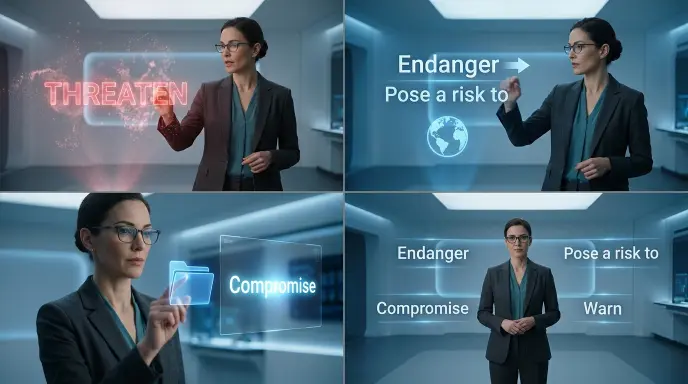
Warn Someone
Meaning: To tell someone about possible danger or consequences.
Example: The teacher warned students about the slippery floor.
Best Use: Almost any context where a genuine warning is intended.
Worst Use: It can soften the meaning too much if deliberate intimidation is involved.
Tone: Neutral.
Signal Danger
Meaning: To show or indicate that danger may exist.
Example: The warning lights signaled danger ahead.
Best Use: Reports, safety writing, and technical descriptions.
Worst Use: It is not a direct synonym when a person verbally threatens someone.
Tone: Neutral and factual.
Indicate a Risk
Meaning: To show that a possible problem or danger exists.
Example: The report indicates a risk to the project’s schedule.
Best Use: Business, academic, and analytical writing.
Worst Use: It is too neutral for deliberate threatening behavior.
Tone: Professional.
Pose a Risk
Meaning: To create a possibility of harm, loss, or difficulty.
Example: The outdated software poses a security risk.
Best Use: Reports, workplace communication, and technical writing.
Worst Use: Do not use it as a direct replacement for a personal threat.
Tone: Neutral and professional.
Raise a Concern
Meaning: To point out something that may cause a problem.
Example: The audit raised concerns about data security.
Best Use: Workplace emails, reports, and meetings.
Worst Use: It is far less forceful than threaten.
Tone: Polite and professional.
Put Pressure On
Meaning: To strongly influence someone to make a decision or take an action.
Example: The deadline put pressure on the team to finish the project.
Best Use: Business and everyday situations.
Worst Use: It should not automatically imply a threat.
Tone: Neutral.
Give an Ultimatum
Meaning: To demand a specific action with a stated consequence if the demand is not followed.
Example: The supplier gave the company an ultimatum about payment.
Best Use: Situations involving a clear demand and consequence.
Worst Use: Avoid it when there is only a general warning.
Tone: Strong and serious.
Imply Harm
Meaning: To suggest possible harm without stating it directly.
Example: His comments seemed to imply harm if the agreement was rejected.
Best Use: Careful descriptions of indirect threats.
Worst Use: Avoid claiming an implied threat when the context does not support that interpretation.
Tone: Formal and cautious.
Signal a Consequence
Meaning: To indicate that a particular result may follow an action.
Example: The notice signaled serious consequences for continued violations.
Best Use: Formal notices and professional writing.
Worst Use: It may sound vague when a direct warning is required.
Tone: Formal and neutral.
Informal and Casual Alternatives:

Scare
Meaning: To make someone feel afraid.
Example: The sudden noise scared everyone in the room.
When It Sounds Natural: Everyday conversation.
When to Avoid It: Formal reports or legal writing.
Tone: Casual.
Frighten
Meaning: To make someone afraid.
Example: The threatening message frightened the family.
When It Sounds Natural: General conversation and ordinary writing.
When to Avoid It: When you specifically mean coercion or a formal threat.
Tone: Neutral to slightly emotional.
Bully
Meaning: To repeatedly use power, pressure, or intimidation against someone.
Example: The older student tried to bully the younger student.
When It Sounds Natural: School, workplace, and social contexts.
When to Avoid It: Do not use it for every isolated disagreement.
Tone: Direct and negative.
Talk Tough
Meaning: To speak aggressively or confidently, often without taking actual action.
Example: He likes to talk tough during arguments.
When It Sounds Natural: Casual conversations.
When to Avoid It: Formal writing and professional reports.
Tone: Informal.
Push Someone Around
Meaning: To treat someone unfairly by using power or authority.
Example: She refused to let her coworkers push her around.
When It Sounds Natural: Everyday conversation.
When to Avoid It: Academic, legal, or formal business writing.
Tone: Informal.
True Synonyms vs. Contextual Alternatives:
Not every word connected to threaten can replace it directly. The distinction matters because changing one word can change the meaning of a sentence.
| Type | What It Means | Can It Replace the Original? |
|---|---|---|
| True synonym | Has nearly the same core meaning | Often, depending on context |
| Near synonym | Shares part of the meaning but adds a different idea | Sometimes |
| Contextual alternative | Works only in certain situations | Only in suitable contexts |
| Broader expression | Covers a wider idea | Sometimes, but meaning may become less precise |
| Narrower expression | Describes a more specific type of threat | Only when that specific meaning applies |
For example, warn is related to threaten, but it is not always a true synonym. A warning can be helpful and protective, while a threat normally suggests an intention or possibility of harm or an unwanted consequence.
Likewise, coerce involves pressure intended to force an action, while intimidate focuses more on creating fear or reducing someone’s confidence.
Business Writing: Alternatives to Threaten:
Business writing usually benefits from precise and neutral language. Instead of saying a decision will threaten the company, you might write:
- The decision could jeopardize the project.
- The change may pose a financial risk.
- The issue could endanger customer safety.
- The delay may put the schedule at risk.
- The findings raise concerns about compliance.
These choices describe the actual risk without making the sentence sound unnecessarily aggressive.
Corporate Communication:
Corporate communication often requires careful wording. A policy might say that repeated violations could result in disciplinary action rather than saying employees will be threatened with punishment.
For example:
Continued violations may result in disciplinary action under company policy.
This is clearer and more professional because it identifies the consequence without using emotionally charged language.
Academic Writing:
Academic writing often needs analytical terms rather than emotionally strong words. Depending on the subject, useful choices include:
- Pose a risk
- Create a danger
- Endanger
- Jeopardize
- Increase the likelihood of harm
- Present a challenge
- Signal a potential consequence
Example:
Poor water management may jeopardize agricultural productivity in affected regions.
Here, jeopardize is more precise than threaten because the sentence describes a risk to an outcome rather than a direct personal threat.
Customer Service:
Customer service language should usually be calm and factual.
Instead of:
The customer threatened our employee.
A more detailed description might be:
The customer made statements that appeared threatening toward the employee.
Or, when appropriate:
The customer warned the employee that he intended to file a formal complaint.
The best wording depends on what was actually said or done.
Legal Writing:
Legal contexts require particular care because threaten, intimidate, coerce, harass, and warn can describe different conduct.
For example, coerce emphasizes forcing someone to act, while intimidate emphasizes creating fear or pressure. Warn can describe a lawful communication about a possible consequence.
A legal document should use the term that accurately describes the facts rather than selecting the strongest-sounding word.
Professional Email Examples Using Alternatives:
Client Warning Email
Subject: Important Notice About Your Account
Hello Sarah,
I wanted to make you aware that the current payment delay may put the project schedule at risk. If the outstanding balance remains unresolved, we may need to adjust the delivery timeline.
Please let me know if you would like to discuss the available options.
Best,
Daniel
Workplace Safety Email
Subject: Safety Concern in the Storage Area
Hi Team,
The damaged shelving poses a safety risk to anyone working in the storage area. Please avoid using that section until the maintenance team has completed its inspection.
Thank you for your cooperation.
Best,
Megan
Project Risk Email
Subject: Project Timeline Update
Hi James,
The supplier delay could jeopardize our current delivery schedule. We are reviewing alternative options and will share an updated timeline tomorrow.
Regards,
Alex
Customer Service Email
Subject: Follow-Up on Your Complaint
Dear Mr. Lee,
Thank you for contacting us. We understand your concern and have forwarded the matter to the appropriate team. We will review the issue and provide an update as soon as possible.
Kind regards,
Customer Support
Vendor Communication Email
Subject: Payment and Delivery Schedule
Hello Mark,
The outstanding invoice may affect the next delivery if it remains unresolved. Please confirm the expected payment date so we can coordinate the schedule accordingly.
Thank you,
Rachel
Short Dialogue Examples:
Workplace Conversation
Person A: The new deadline could put the project at risk.
Person B: I agree. We should tell the manager before it becomes a bigger issue.
Classroom Conversation
Person A: The teacher warned us about the wet floor.
Person B: Good thing she told us before anyone slipped.
Customer Service Conversation
Person A: The customer said he would report the issue if we did not respond.
Person B: That sounds more like a warning about a possible complaint than a personal threat.
Casual Conversation
Person A: Why did you leave the game early?
Person B: Someone kept trying to scare me. I didn’t want to argue.
Professional Discussion
Person A: Could this decision jeopardize the contract?
Person B: It could, so we should review the terms before moving forward.
How to Replace “Threaten” in a Sentence:
Example 1
Original: The storm threatened the village.
Alternative: The storm posed a danger to the village.
Why it works: This focuses on physical danger rather than intentional action.
Example 2
Original: The delay threatened the project.
Alternative: The delay jeopardized the project.
Why it works: Jeopardize is more precise for something that puts success at risk.
Example 3
Original: He threatened the employee.
Alternative: He intimidated the employee.
Why it works: Intimidated emphasizes the fear or pressure experienced by the employee.
Example 4
Original: She threatened to report the company.
Alternative: She warned that she would report the company.
Why it works: Warn can sound more neutral when the person is informing someone about an intended action.
Example 5
Original: The policy threatens their privacy.
Alternative: The policy could endanger their privacy.
Why it works: Endanger emphasizes possible harm rather than deliberate intent.
Example 6
Original: He threatened me into signing the document.
Alternative: He coerced me into signing the document.
Why it works: Coerce specifically describes forcing someone to act through pressure or threats.
Example 7
Original: The rising costs threaten the business.
Alternative: The rising costs put the business at risk.
Why it works: This is clear and neutral for business communication.
Example 8
Original: The manager threatened disciplinary action.
Alternative: The manager warned that disciplinary action could follow.
Why it works: The alternative presents the consequence as a formal warning rather than focusing on threatening language.
Threaten vs. Warn: What Is the Difference?
Threaten usually suggests an unwanted consequence, harm, or hostile action. Warn usually means informing someone about a possible danger or consequence.
Compare:
- He threatened to damage the property.
- He warned us that the property was unsafe.
The first sentence suggests an intention to cause harm. The second gives information about an existing danger.
Threaten vs. Intimidate: What Is the Difference?
Threaten often involves communicating a possible harmful consequence. Intimidate focuses on making someone afraid or less willing to resist.
Someone can intimidate another person without making a direct threat.
Threaten vs. Menace: What Is the Difference?
Menace is stronger and more formal than ordinary threaten. It can describe a person, force, or situation that represents serious danger.
For everyday writing, threaten is usually more natural.
Threaten vs. Coerce: What Is the Difference?
Coerce means using pressure, threats, or force to make someone do something. It therefore describes a specific purpose.
For example:
The suspect threatened the witness.
This describes threatening behavior.
The suspect coerced the witness into changing the statement.
This emphasizes the pressure used to produce an action.
Which Alternative Should You Choose?
Best for Formal Writing
Use menace, endanger, jeopardize, imperil, pose a risk, or indicate a danger, depending on the meaning.
Best for Business Communication
Use jeopardize, pose a risk, put at risk, raise concerns, or create a potential problem.
Best for Academic Writing
Use jeopardize, endanger, pose a risk, or present a danger when the context supports them.
Best for Legal Writing
Choose the most factually precise term. Threaten, intimidate, coerce, and warn should not be treated as interchangeable.
Best for Professional Emails
Use neutral expressions such as pose a risk, put at risk, raise concerns, or warn when appropriate.
Best for Everyday Conversation
Scare, frighten, warn, threaten, and bully may sound natural depending on the situation.
Best for Casual Messages
Use simple words such as scare, warn, frighten, or push around when the context is informal.
Grammar and Usage Guide:
Common Sentence Structures
Common patterns include:
Someone threatened someone.
Someone threatened to do something.
Someone threatened someone with something.
Examples:
The man threatened the driver.
She threatened to resign.
They threatened the company with legal action.
Natural Word Combinations
Common combinations include:
- Threaten someone’s safety
- Threaten someone’s life
- Threaten legal action
- Threaten to resign
- Threaten to leave
- Threaten violence
- Threaten national security
- Threaten a business
- Threaten the environment
Verb Forms of Threaten
The main forms are:
- Base form: threaten
- Third-person singular: threatens
- Past tense: threatened
- Present participle: threatening
Examples:
They threaten to cancel the agreement.
The policy threatens local businesses.
He threatened to complain.
The message sounded threatening.
Common Mistakes When Using Synonyms for Threaten:
Confusing Threaten With Warn
A warning can be protective or informative, while a threat generally carries a more hostile or harmful meaning.
Using Intimidate Incorrectly
Intimidate focuses on creating fear or pressure. It does not always mean that a direct threat was made.
Choosing an Overly Aggressive Word
Words such as menace can sound much stronger than the original sentence requires.
Changing the Original Meaning
Replacing threaten with jeopardize changes the sentence from intentional threatening behavior to risk or danger.
Using Casual Language in Formal Writing
Words such as scare or talk tough may sound inappropriate in academic or professional documents.
Ignoring Context and Tone
The same situation can be described differently depending on whether the audience is a customer, teacher, manager, lawyer, or friend.
Using Vague Wording
Phrases such as “created a bad situation” may be too unclear when a more precise term such as “posed a safety risk” is available.
When Not to Use the Word Threaten:
When You Mean Warn
Use warn when the purpose is to inform someone about a possible danger.
When You Mean Create a Risk
Use endanger, jeopardize, or put at risk when something creates potential harm.
When You Mean Pressure Someone
Use pressure or coerce when the main idea is forcing someone toward an action.
When a Neutral Expression Is Better
Use pose a risk or raise concerns when you want professional, objective language.
Threaten is still the better choice when someone actually communicates an intention to cause harm or impose an unwanted consequence.
Advanced Tips for Choosing the Right Alternative:
Control the Tone
Choose warn for a neutral warning, intimidate for fear-based pressure, and threaten when an unwanted consequence is deliberately communicated.
Match the Audience
A casual phrase such as “scare someone” may work in conversation but not in a formal report.
Choose Precise Language
Ask what actually happened. Was there a warning, a risk, intimidation, coercion, or direct threat? The answer should determine the word.
Keep Professional Emails Polite
Instead of dramatic wording, explain the consequence clearly.
The delay may affect the delivery schedule.
This is usually more useful than saying:
The delay threatens the entire project.
Improve Readability
Simple alternatives are often stronger than complicated ones. If put at risk communicates the idea clearly, there may be no reason to use the more formal imperil.
Related Questions About Threaten:
What Is Another Word for Threaten?
Common alternatives include warn, intimidate, menace, coerce, frighten, scare, bully, and pressure. The correct choice depends on whether you mean a direct threat, fear, risk, warning, or pressure.
What Is a Professional Word for Threaten?
In professional writing, warn, indicate a risk, pose a danger, jeopardize, endanger, and put at risk can be useful alternatives. The best option depends on the exact meaning.
What Is a Formal Synonym for Threaten?
Formal alternatives include menace, intimidate, coerce, endanger, jeopardize, and imperil. Some are only contextual alternatives, so they should not automatically replace threaten.
Is Threaten a Formal Word?
Threaten is a standard word used in both formal and informal English. Its suitability depends more on the situation than on formality. In professional writing, a more precise alternative may sometimes communicate the intended meaning better.
What Is the Difference Between Threaten and Warn?
Threaten generally communicates an unwanted consequence or possible harm, while warn usually informs someone about a danger or consequence. A warning does not necessarily involve hostile intent.
Can Intimidate Be Used Instead of Threaten?
Sometimes. Intimidate emphasizes making someone afraid or pressured, while threaten often emphasizes communicating a possible harmful consequence. They overlap but are not identical.
What Can I Say Instead of Threaten?
You can use warn, intimidate, menace, coerce, endanger, jeopardize, pressure, pose a risk, or put at risk, depending on the sentence and intended meaning.
FAQs:
What Is the Closest Synonym for Threaten?
Menace is one of the closest formal alternatives, while intimidate is close when the focus is on creating fear. Neither is interchangeable with threaten in every sentence, so context still matters.
What Is a Formal Word for Threaten?
Formal choices include menace, intimidate, coerce, imperil, and endanger. However, each carries a slightly different meaning. For example, imperil means put in serious danger rather than make a direct verbal threat.
Is Warn the Same as Threaten?
No. Warn usually means informing someone about danger or consequences, while threaten commonly suggests an unwanted consequence or possible harm. A warning can be helpful and protective; a threat is generally more hostile.
What Is the Difference Between Threaten and Intimidate?
Threaten often involves communicating a possible harmful consequence. Intimidate focuses on making someone afraid, pressured, or less confident. A person can therefore be intimidating without making an explicit threat.
What Is Another Word for Threatening Someone?
Depending on the situation, you could use intimidating, menacing, bullying, pressuring, or coercing. The best word depends on whether fear, danger, force, or pressure is the main idea.
What Is a Professional Alternative to Threaten?
For professional communication, alternatives such as warn, pose a risk, jeopardize, put at risk, raise concerns, and endanger can sound more precise and neutral when they accurately describe the situation.
What Is the Opposite of Threaten?
Possible opposites include reassure, protect, comfort, encourage, support, and secure, depending on the meaning. The exact opposite changes according to whether threaten means causing fear, creating danger, or promising harm.
Key Takeaways:
- Threaten can describe communicating harm, danger, or an unwanted consequence.
- Warn is usually more neutral and informative than threaten.
- Intimidate focuses on creating fear or pressure.
- Coerce means using pressure or threats to make someone act.
- Choose alternatives such as jeopardize, endanger, or pose a risk when you mean danger rather than a direct threat.
Conclusion:
The best synonym for threaten depends on the exact idea you want to communicate. If you mean giving information about possible danger, warn or caution may be better. If the focus is fear or pressure, intimidate is often more accurate. For forcing someone to act, coerce is more precise. When you are describing general danger or risk, words such as endanger, jeopardize, imperil, and pose a risk can improve professional and academic writing.The key is not simply to replace one word with another. Think about the action, intention, tone, and audience first. A precise synonym makes your sentence clearer and prevents readers from misunderstanding what happened.