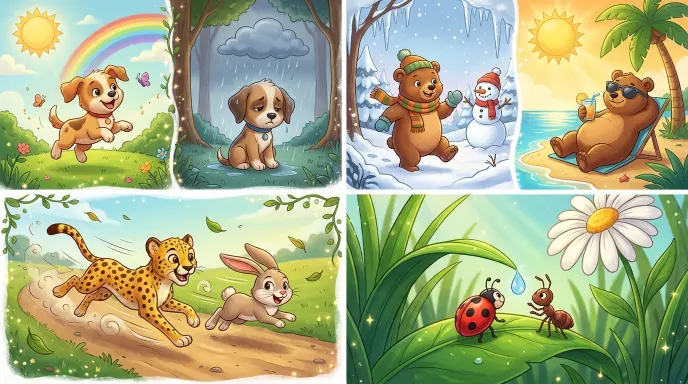
Learning new words can be an exciting adventure for children. Synonyms and antonyms help kids understand how words are connected, express their thoughts clearly, and build stronger vocabulary skills. A fun synonyms and antonyms video for kids makes this learning process easier by using colorful pictures, simple explanations, familiar examples, and enjoyable activities.
Children often learn faster when they can see and hear examples instead of memorizing long definitions. For example, they can learn that happy means joyful and that its opposite is sad. Similarly, big and large have similar meanings, while big and small have opposite meanings. These simple word relationships help children become more confident readers, writers, and speakers.
What Are Synonyms and Antonyms for Kids?
Synonyms and antonyms are two important parts of English vocabulary. They help children understand different word meanings and use language more creatively.
What Are Synonyms?
Synonyms are words that have the same or nearly the same meaning. Children can use them to express an idea in different ways.
For example:
- Happy – Joyful
- Big – Large
- Small – Tiny
- Smart – Clever
- Fast – Quick
- Beautiful – Pretty
Example sentence:
- The girl is happy.
- The girl is joyful.
Both sentences express a similar idea.
What Are Antonyms?
Antonyms are words that have opposite meanings. They help children understand differences between things, feelings, actions, and situations.
For example:
- Hot – Cold
- Up – Down
- Day – Night
- Happy – Sad
- Tall – Short
- Open – Closed
Example sentence:
- The water is hot.
- The water is cold.
These sentences describe opposite conditions.
Why Should Kids Learn Synonyms and Antonyms?
Learning similar and opposite words helps children develop important language skills. It also makes everyday communication easier.
Some important benefits include:
- Builds a stronger English vocabulary.
- Improves reading and writing abilities.
- Helps children understand word meanings.
- Encourages creative thinking.
- Makes sentence formation easier.
- Improves speaking confidence.
- Helps children describe people, places, and objects.
How Videos Make Learning New Words Fun
Educational videos make vocabulary lessons more interesting for young learners. Children can watch animations, listen to pronunciation, and see pictures that explain different words.
For example, a video can show a smiling child to explain happy and a crying child to explain sad. This visual connection helps children remember the words.
Synonyms and Antonyms Examples for Kids
Children can learn vocabulary more easily through simple examples. The following lists introduce common words that kids can use at home, at school, and in everyday conversations.
Easy Synonyms for Everyday Words
| Word | Synonym |
|---|---|
| Happy | Joyful |
| Sad | Unhappy |
| Big | Large |
| Small | Tiny |
| Fast | Quick |
| Smart | Clever |
| Beautiful | Pretty |
| Funny | Amusing |
| Angry | Mad |
| Begin | Start |
| End | Finish |
| Gift | Present |
| Help | Assist |
| Quiet | Silent |
| Easy | Simple |
| Brave | Courageous |
| Near | Close |
| Rich | Wealthy |
| Speak | Talk |
| Choose | Select |
Common Antonyms for Everyday Words
| Word | Antonym |
|---|---|
| Hot | Cold |
| Big | Small |
| Happy | Sad |
| Up | Down |
| In | Out |
| Day | Night |
| Old | Young |
| Tall | Short |
| Fast | Slow |
| Strong | Weak |
| Clean | Dirty |
| Open | Closed |
| Full | Empty |
| Light | Dark |
| Early | Late |
| Hard | Soft |
| Wet | Dry |
| Laugh | Cry |
| Give | Take |
| Love | Hate |
Synonyms and Antonyms for Beginners
Here are some additional word pairs that help young learners understand similar and opposite meanings.
| Word | Synonym | Antonym |
|---|---|---|
| Beautiful | Pretty | Ugly |
| Clever | Smart | Foolish |
| Quiet | Silent | Noisy |
| Kind | Caring | Cruel |
| Brave | Fearless | Cowardly |
| Easy | Simple | Difficult |
| Begin | Start | End |
| Rich | Wealthy | Poor |
| Safe | Secure | Dangerous |
| Polite | Courteous | Rude |
| Bright | Shiny | Dull |
| Weak | Feeble | Strong |
Simple Word Pairs Kids Should Know
Kids can also practice these everyday vocabulary pairs:
- Above – Below
- Before – After
- Inside – Outside
- Front – Back
- Left – Right
- Sweet – Sour
- Thick – Thin
- Empty – Full
- Push – Pull
- Win – Lose
These examples are useful for basic English lessons because children can connect them with familiar objects, actions, and experiences.
Fun Synonyms for Kids With Examples
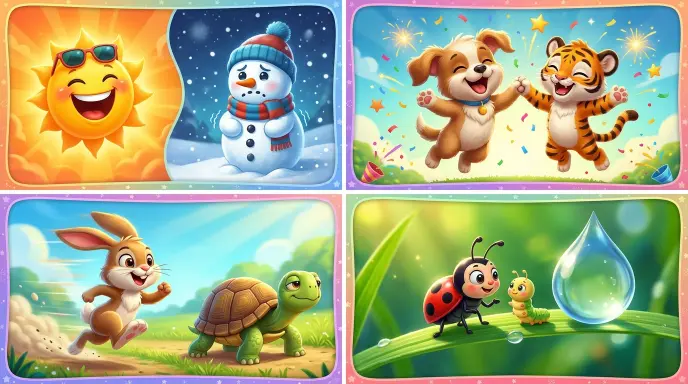
Synonyms help children discover different ways to describe the same thing. Here are some common examples with easy explanations.
Synonyms for Happy
Happy describes a feeling of pleasure or joy.
- Joyful
- Cheerful
- Glad
- Pleased
- Delighted
Example: The children were happy after winning the game.
Alternative: The children were delighted after winning the game.
Synonyms for Sad
Sad describes a feeling of unhappiness.
- Unhappy
- Upset
- Gloomy
- Downhearted
- Miserable
Example: The boy felt sad when his friend moved away.
Alternative: The boy felt unhappy when his friend moved away.
Synonyms for Big
Big describes something large in size or amount.
- Large
- Huge
- Giant
- Enormous
- Massive
Example: We saw a big elephant at the zoo.
Alternative: We saw a huge elephant at the zoo.
Synonyms for Small
Small describes something that has a little size or amount.
- Tiny
- Little
- Miniature
- Petite
- Compact
Example: She has a small puppy.
Alternative: She has a tiny puppy.
Synonyms for Beautiful
Beautiful describes something that looks very attractive or pleasing.
- Pretty
- Lovely
- Attractive
- Gorgeous
- Charming
Example: The garden looks beautiful.
Alternative: The garden looks lovely.
Synonyms for Smart
Smart describes someone who learns quickly or makes good decisions.
- Clever
- Bright
- Intelligent
- Sharp
- Brainy
Example: Ali is a smart student.
Alternative: Ali is a clever student.
Synonyms for Fast
Fast describes something that moves or happens quickly.
- Quick
- Speedy
- Rapid
- Swift
- Hasty
Example: The rabbit is fast.
Alternative: The rabbit is quick.
Synonyms for Funny
Funny describes something that makes people laugh.
- Amusing
- Hilarious
- Comical
- Humorous
- Entertaining
Example: The cartoon was funny.
Alternative: The cartoon was hilarious.
Common Antonyms for Kids With Examples
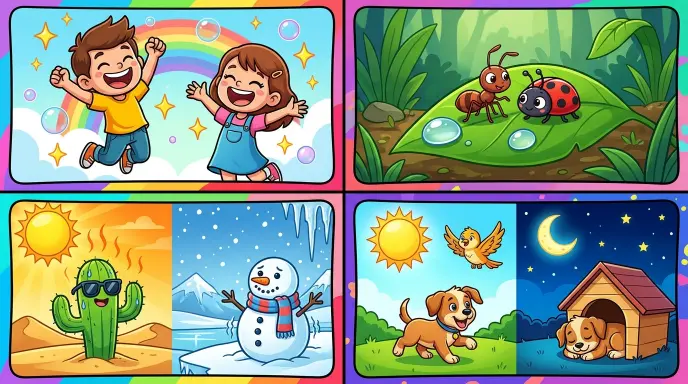
Antonyms make it easier for children to understand differences. They can learn these words through pictures, classroom games, and everyday situations.
Hot and Cold
Hot means having a high temperature, while cold means having a low temperature.
Example: The soup is hot, but the ice cream is cold.
Happy and Sad
Happy describes a joyful feeling, while sad describes an unhappy feeling.
Example: Sara is happy because she received a gift, but her brother is sad because he lost his toy.
Big and Small
Big describes something large, while small describes something little.
Example: An elephant is big, but a mouse is small.
Up and Down
Up describes movement or position toward a higher place. Down describes movement or position toward a lower place.
Example: The balloon went up, and the toy fell down.
Day and Night
Day is the time when it is light outside, while night is the darker part of the daily cycle.
Example: We go to school during the day and sleep at night.
Open and Closed
Open means something is not shut. Closed means something is shut.
Example: The door is open, but the window is closed.
Strong and Weak
Strong describes someone or something with great power. Weak describes someone or something with little strength.
Example: The strong boy lifted the box, but the weak puppy could not move it.
Clean and Dirty
Clean means free from dirt. Dirty means covered with dirt or stains.
Example: My clothes were clean before I played outside, but now they are dirty.
Synonyms and Antonyms Video Activities for Kids

Watching an educational video is a great way to introduce new vocabulary. However, children learn even more when they participate in activities after watching.
Watch and Learn New Words
Choose a short educational video that explains simple synonyms and antonyms. Encourage children to repeat each word after hearing it.
For example, show the words big and large. Ask children to say both words aloud and explain what they mean.
Match the Synonyms Game
Write different words on small cards. Ask children to find two cards with similar meanings.
For example:
- Happy – Joyful
- Small – Tiny
- Fast – Quick
- Smart – Clever
This activity improves vocabulary recognition and memory.
Find the Opposite Word
Say a word and ask children to provide its opposite.
Try these examples:
- Hot – Cold
- Up – Down
- Happy – Sad
- Day – Night
- Tall – Short
Make the activity more exciting by giving children a few seconds to answer.
Picture-Based Vocabulary Activities
Pictures are especially helpful for young children who are learning basic English.
Show two pictures that represent opposite meanings. For example, use a picture of a full glass and an empty glass.
Ask children to identify the words full and empty.
Repeat and Remember Word Pairs
Repetition helps children remember unfamiliar vocabulary.
Choose five word pairs each day and ask children to repeat them. Review the previous words before introducing new ones.
Easy Synonyms and Antonyms Exercises for Kids
Practice activities help children test what they have learned. These simple exercises can be used by parents and teachers.
Choose the Correct Synonym
Select the word with a similar meaning.
- Happy: Sad / Joyful / Angry
- Big: Large / Tiny / Short
- Fast: Slow / Quick / Weak
- Smart: Clever / Foolish / Lazy
- Small: Huge / Tiny / Tall
Answers: 1. Joyful, 2. Large, 3. Quick, 4. Clever, 5. Tiny.
Fill in the Missing Opposite
Write the opposite word in each blank.
- Hot – ______
- Up – ______
- Happy – ______
- Clean – ______
- Strong – ______
- Open – ______
- Fast – ______
- Day – ______
Answers: Cold, Down, Sad, Dirty, Weak, Closed, Slow, Night.
Match Words With Their Meanings
Match each word with its correct synonym.
| Word | Correct Synonym |
|---|---|
| 1. Begin | A. Tiny |
| 2. Small | B. Start |
| 3. Smart | C. Quick |
| 4. Fast | D. Clever |
Answers: 1-B, 2-A, 3-D, 4-C.
Complete the Sentences
Choose the correct word to complete each sentence.
- The opposite of hot is ______.
- A synonym for happy is ______.
- The opposite of big is ______.
- A synonym for fast is ______.
- The opposite of clean is ______.
Answers: Cold, Joyful, Small, Quick, Dirty.
Identify the Similar and Opposite Words
Ask children to identify whether each pair contains synonyms or antonyms.
- Big – Large
- Hot – Cold
- Happy – Joyful
- Up – Down
- Small – Tiny
- Strong – Weak
Answers:
- Synonyms
- Antonyms
- Synonyms
- Antonyms
- Synonyms
- Antonyms
Fun Classroom Games to Teach Synonyms and Antonyms
Classroom games turn vocabulary lessons into enjoyable learning experiences. They also encourage children to work together and share ideas.
Word Matching Challenge
Give each student a collection of word cards. Ask them to match similar words as quickly as possible.
For example, students can match beautiful with pretty and quick with fast.
Opposite Word Hunt
Choose a word and ask students to find its opposite somewhere in the classroom vocabulary cards.
For example, if the teacher says empty, students must find full.
Synonym Memory Game
Place word cards face down on a table. Children take turns turning over two cards to find words with similar meanings.
This game improves concentration and vocabulary recall.
Flashcard Vocabulary Game
Create colorful flashcards with one word on each card. Write its synonym or antonym on another card.
Children can use the cards to practice matching and pronunciation.
Team-Based Word Competition
Divide the classroom into two teams. Give each team a word and ask them to find its synonym or antonym.
Award a point for every correct answer. This makes vocabulary practice exciting and encourages teamwork.
How Parents and Teachers Can Help Kids Learn
Children need regular practice to understand and remember new words. Parents and teachers can make learning easier through simple daily activities.
Practice New Words Every Day
Introduce a few new words each day instead of giving children a long vocabulary list.
For example, teach happy, joyful, and sad together. Ask children to use these words in their own sentences.
Use Pictures and Real-Life Objects
Show children objects around the house or classroom.
A large book and a small book can explain the difference between big and small. A clean plate and a dirty plate can demonstrate opposite meanings.
Encourage Kids to Make Their Own Sentences
Ask children to create sentences using new vocabulary.
For example:
- The rabbit is fast.
- The turtle is slow.
- My room is clean.
- My shoes are dirty.
Creating sentences helps children understand how words work in context.
Read Children’s Books Together
Reading simple stories introduces children to new vocabulary naturally.
Stop occasionally and ask questions about unfamiliar words. Encourage children to suggest similar or opposite words.
Make Vocabulary Learning Enjoyable
Use songs, rhymes, puzzles, flashcards, and educational videos to keep children interested.
Avoid turning every activity into a test. Children should feel comfortable making mistakes and trying again.
Benefits of Learning Synonyms and Antonyms
Understanding word relationships supports children’s language development in several ways.
Builds a Strong Vocabulary
Children learn more words and discover different ways to express their thoughts.
Instead of always using happy, they can use glad, joyful, or cheerful when appropriate.
Improves Reading Skills
Knowing synonyms and antonyms helps children understand unfamiliar words while reading stories and schoolbooks.
They can use familiar meanings and opposites to understand new vocabulary.
Develops Better Writing Skills
Synonyms help children avoid repeating the same words in their writing.
For example, instead of writing “The big dog ran fast,” they might write “The large dog ran quickly.”
Makes Communication Easier
A stronger vocabulary helps children explain their feelings, describe objects, and share ideas with others.
Encourages Creative Thinking
Children learn that one idea can be expressed in different ways. They also become better at noticing similarities and differences.
Common Mistakes Kids Make When Learning Word Pairs
Children sometimes confuse similar and opposite words. A little guidance can help them understand these differences.
Confusing Synonyms With Antonyms
Synonyms have similar meanings, while antonyms have opposite meanings.
For example, big and large are synonyms, but big and small are antonyms.
Choosing Words With Different Meanings
Not every related word is a synonym.
For example, angry and shout are connected, but they do not mean the same thing. One describes a feeling, while the other describes an action.
Forgetting Word Meanings
Memorizing word pairs without understanding them can make learning difficult.
Children should practice using new words in complete sentences.
Using Words in the Wrong Sentences
Some synonyms cannot replace each other in every situation.
For example, thin and slim can both describe body shape, but slim often sounds more positive.
Ignoring Context and Meaning
A word can have different meanings depending on the sentence.
For example, bright can describe a strong light or an intelligent person. Children should learn words through examples.
Frequently Asked Questions About Synonyms and Antonyms for Kids
What Are Synonyms and Antonyms in Simple Words?
Synonyms are words with similar meanings, while antonyms are words with opposite meanings. For example, happy and joyful are synonyms, whereas happy and sad are antonyms.
How Can Kids Learn Synonyms and Antonyms Easily?
Kids can learn through educational videos, picture cards, word games, simple stories, and daily conversations. Practicing a few words every day helps them remember meanings and use vocabulary correctly.
What Are Five Examples of Synonyms?
Five simple synonym pairs are:
- Happy – Joyful
- Big – Large
- Small – Tiny
- Fast – Quick
- Smart – Clever
These words have similar meanings, although some may differ slightly in tone or usage.
What Are Five Examples of Antonyms?
Five common antonym pairs include:
- Hot – Cold
- Up – Down
- Happy – Sad
- Big – Small
- Clean – Dirty
Children can use these pairs to understand opposite meanings.
At What Age Should Children Learn Synonyms and Antonyms?
Children can begin learning simple similar and opposite words during their early school years. The right time depends on their language development, reading ability, and familiarity with basic vocabulary.
Are Synonyms and Antonyms Important for Vocabulary Development?
Yes. They help children understand word meanings, improve sentence formation, and develop stronger reading and writing skills. They also make everyday communication more expressive.
Can Educational Videos Help Kids Learn New Words?
Yes. Educational videos can make vocabulary lessons more engaging through pictures, sounds, pronunciation, and examples. Children benefit most when they combine watching with speaking, reading, and practical exercises.
Key Takeaways
- Synonyms are words with similar meanings, while antonyms have opposite meanings.
- Educational videos make vocabulary learning more interesting through pictures and sounds.
- Word games and flashcards help children remember new vocabulary.
- Using new words in sentences improves reading, writing, and speaking skills.
- Daily practice helps children become more confident English learners.
Conclusion: Make Vocabulary Learning Fun for Kids
Learning synonyms and antonyms does not have to feel like a difficult school lesson. With colorful videos, simple examples, and enjoyable activities, children can discover new words while having fun. Starting with familiar pairs such as happy and joyful, big and large, or hot and cold gives young learners a strong foundation in English vocabulary.
Parents and teachers can make a big difference by encouraging children to practice new words through conversations, stories, flashcards, and classroom games. They should also explain that similar words do not always have exactly the same meaning, so using the right word in the right situation matters.
A good learning routine combines watching, listening, speaking, reading, and writing. Keep lessons short, celebrate small improvements, and allow children to explore language at their own pace. With regular practice, kids can build stronger vocabulary skills and become more confident communicators.