

A chuckle is a quiet, soft laugh, usually showing mild amusement, pleasure, or friendliness. Unlike a loud laugh, a chuckle is often controlled and subtle. You might chuckle at a clever joke, a funny comment, or an amusing situation. Because the word has a particular tone, choosing another expression depends on how strong, formal, or casual the laughter is.
Writers often search for synonyms for chuckle to avoid repetition or describe laughter more precisely. Words such as giggle, snicker, laugh, grin, chortle, and titter can work in some contexts, but they do not all mean exactly the same thing. The best choice depends on the person’s emotion, the volume of the laugh, and the situation.
Quick Answer:
The closest synonyms for chuckle include laugh, chortle, giggle, snicker, titter, grin, smile, and laugh quietly. However, each carries a slightly different meaning. Chortle suggests cheerful laughter, giggle often sounds light or high-pitched, while snicker can suggest amusement at something inappropriate.
Quick List of Synonyms for Chuckle:
Closest Alternatives
- Laugh
- Chortle
- Giggle
- Snicker
- Titter
- Smile
- Grin
- Laugh softly
- Laugh quietly
- Suppress a laugh
- Let out a laugh
- Give a little laugh
- Amuse oneself
- Laugh under one’s breath
- Make a quiet laugh
Formal and Neutral Alternatives
- Laugh softly
- Laugh quietly
- Smile with amusement
- Express amusement
- Show amusement
- Respond with a quiet laugh
- Give a restrained laugh
- Suppress laughter
- Smile knowingly
- React with amusement
Casual Alternatives
- Giggle
- Snicker
- Chortle
- Crack up
- Have a laugh
- Let out a laugh
- Laugh under your breath
- Grin
- Smirk
Formal Alternatives to Chuckle:

Laugh Softly
Meaning: To laugh in a quiet or controlled way.
Explanation: This is one of the clearest replacements for chuckle because it preserves the idea of quiet laughter without adding a strong emotional meaning.
Example:
She laughed softly at the professor’s unexpected joke.
Best Use: Professional writing, narratives, and descriptive prose.
Worst Use: Highly casual dialogue where a more natural expression may sound better.
Tone: Neutral and descriptive.
Express Amusement
Meaning: To show that something is funny or entertaining.
Explanation: This phrase is broader than chuckle. It does not necessarily mean the person laughed.
Example:
The audience expressed amusement at the speaker’s story.
Best Use: Reports, formal writing, and professional communication.
Worst Use: Casual conversations where it may sound overly formal.
Tone: Formal and neutral.
Show Amusement
Meaning: To visibly or verbally indicate enjoyment of something funny.
Explanation: A person may show amusement by smiling, laughing, or reacting positively.
Example:
The manager showed amusement at the unusual suggestion.
Best Use: Formal descriptions.
Worst Use: Direct dialogue.
Tone: Neutral to formal.
Give a Restrained Laugh
Meaning: To laugh while keeping the reaction controlled.
Explanation: This is more specific than chuckle because it emphasizes self-control.
Example:
He gave a restrained laugh during the serious meeting.
Best Use: Professional and narrative contexts.
Worst Use: Situations involving loud or uncontrollable laughter.
Tone: Formal and controlled.
Laugh Under One’s Breath
Meaning: To laugh very quietly.
Explanation: This phrase is close to chuckle, although it can suggest that the person is trying not to be heard.
Example:
She laughed under her breath when she noticed the mistake.
Best Use: Narrative writing and informal descriptions.
Worst Use: Formal reports where a simpler phrase is clearer.
Tone: Quiet and conversational.
Smile with Amusement
Meaning: To smile because something is funny or entertaining.
Explanation: This is not an exact synonym because smiling does not necessarily involve laughter.
Example:
The teacher smiled with amusement at the student’s creative answer.
Best Use: Descriptive writing.
Worst Use: When actual laughter is important.
Tone: Warm and neutral.
Respond with a Quiet Laugh
Meaning: To answer or react by laughing softly.
Explanation: This phrase describes a response rather than simply naming the laugh.
Example:
She responded with a quiet laugh when asked about the incident.
Best Use: Narratives and professional descriptions.
Worst Use: Short, casual speech.
Tone: Neutral.
Suppress a Laugh
Meaning: To try not to laugh.
Explanation: This differs from chuckle because the focus is on controlling or hiding laughter.
Example:
He tried to suppress a laugh during the presentation.
Best Use: Workplace, classroom, and narrative contexts.
Worst Use: When the person freely laughs.
Tone: Neutral.
React with Amusement
Meaning: To respond to something in an amused way.
Explanation: The reaction may involve laughter, smiling, or another sign of enjoyment.
Example:
The audience reacted with amusement to the unexpected comment.
Best Use: Reports and formal descriptions.
Worst Use: Casual conversation.
Tone: Formal and neutral.
Smile Knowingly
Meaning: To smile because you understand something amusing or meaningful.
Explanation: This is a contextual alternative rather than a true synonym.
Example:
She smiled knowingly when her colleague mentioned the surprise.
Best Use: Fiction and descriptive writing.
Worst Use: When simple laughter is the intended meaning.
Tone: Subtle and expressive.
Semi-Formal and Neutral Alternatives:

Laugh Quietly
Meaning: To laugh without making much noise.
Explanation: This is perhaps the simplest neutral replacement for chuckle.
Example:
The students laughed quietly at the joke.
Best Use: Everyday writing and school assignments.
Worst Use: When the laugh is loud or dramatic.
Tone: Neutral.
Laugh Gently
Meaning: To laugh in a soft and pleasant way.
Explanation: It can suggest warmth or friendliness rather than simple amusement.
Example:
She laughed gently at the child’s innocent question.
Best Use: Descriptive writing.
Worst Use: Formal technical writing.
Tone: Warm.
Give a Little Laugh
Meaning: To laugh briefly and lightly.
Explanation: This sounds natural in storytelling and casual descriptions.
Example:
He gave a little laugh before answering.
Best Use: Fiction and everyday narration.
Worst Use: Formal business documents.
Tone: Casual and natural.
Let Out a Small Laugh
Meaning: To produce a brief, quiet laugh.
Explanation: It emphasizes the short duration of the reaction.
Example:
She let out a small laugh when she heard the story.
Best Use: Narrative writing.
Worst Use: When the person laughs continuously.
Tone: Neutral.
Give a Quiet Laugh
Meaning: To laugh softly.
Explanation: This is a straightforward descriptive alternative.
Example:
He gave a quiet laugh and continued reading.
Best Use: General writing.
Worst Use: Formal analytical writing.
Tone: Neutral.
Smile
Meaning: To show happiness or amusement with the face.
Explanation: A smile can replace chuckle only when laughter itself is not essential.
Example:
She smiled at the funny comment.
Best Use: Short descriptions.
Worst Use: When audible laughter is part of the scene.
Tone: Neutral.
Grin
Meaning: To smile broadly, often because of amusement or pleasure.
Explanation: A grin is visual rather than auditory, so it is not an exact synonym.
Example:
He grinned when he heard the surprising news.
Best Use: Informal writing and storytelling.
Worst Use: Serious professional communication.
Tone: Casual and expressive.
Show a Hint of Amusement
Meaning: To reveal a small amount of amusement.
Explanation: This expression focuses on subtle emotion rather than laughter itself.
Example:
The editor showed a hint of amusement at the unusual headline.
Best Use: Descriptive prose.
Worst Use: Direct everyday conversation.
Tone: Refined and neutral.
Respond with a Smile
Meaning: To react by smiling.
Explanation: This is useful when the person is amused but does not actually laugh.
Example:
The receptionist responded with a smile to the customer’s joke.
Best Use: Professional and customer-service writing.
Worst Use: When actual laughter matters.
Tone: Polite and neutral.
Informal and Casual Alternatives:
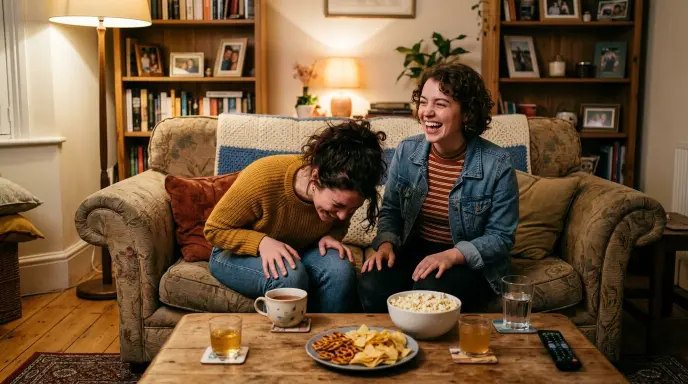
Giggle
Meaning: To laugh lightly, often in a high or repeated way.
Example:
The friends giggled at the silly photo.
When Natural: Friendly conversations and informal storytelling.
When to Avoid: Serious business or academic writing.
Tone: Playful and light.
Snicker
Meaning: To laugh quietly, often because something is amusing in a mischievous or inappropriate way.
Example:
The students snickered when the teacher made a small mistake.
When Natural: Informal storytelling.
When to Avoid: When you want to describe warm, friendly laughter.
Tone: Mischievous or slightly negative.
Chortle
Meaning: To laugh in a cheerful, pleased way.
Example:
Grandpa chortled at the clever joke.
When Natural: Humorous or descriptive writing.
When to Avoid: Highly formal communication.
Tone: Cheerful and expressive.
Crack Up
Meaning: To laugh very hard.
Example:
We cracked up when we saw the video.
When Natural: Casual speech.
When to Avoid: Professional writing.
Tone: Very informal.
Laugh Under Your Breath
Meaning: To laugh very quietly.
Example:
He laughed under his breath during the meeting.
When Natural: Casual conversation and fiction.
When to Avoid: Formal reports.
Tone: Informal and subtle.
True Synonyms vs. Contextual Alternatives:
Not every word connected with chuckle can replace it in every sentence.
| Type | What It Means | Can It Replace the Original? |
|---|---|---|
| True synonym | Nearly the same meaning and function | Usually |
| Near synonym | Similar meaning with a slight difference | Sometimes |
| Contextual alternative | Works in a particular situation | Only in specific contexts |
| Broader expression | Covers a wider range of reactions | Sometimes |
| Narrower expression | Describes a more specific type of laugh | Only when that detail fits |
For example, chortle is close to chuckle, but it often sounds more cheerful. Giggle describes a different style of laughter, while smile does not necessarily involve laughter at all.
Business Writing:
Business writing usually benefits from clear and neutral language.
Instead of writing:
The client chuckled at the proposal.
You might write:
The client laughed softly at the proposal.
Or:
The client reacted with amusement to the proposal.
The second version is useful when you do not know whether the person actually laughed.
Corporate Communication:
Corporate communication often avoids expressive words unless describing an event or conversation.
Useful choices include:
- Laughed softly
- Responded with amusement
- Smiled
- Reacted positively
- Gave a brief laugh
Example:
The team responded with amusement to the unexpected announcement.
Academic Writing:
Academic writing generally favors precise descriptions over expressive vocabulary.
Instead of:
The participants chuckled at the image.
You could write:
The participants showed amusement when viewing the image.
This is more neutral because showed amusement does not assume a particular form of laughter.
Customer Service:
Customer-service communication should sound warm without becoming overly casual.
Example:
The representative smiled and acknowledged the customer’s humorous comment.
Another example:
The customer responded with a light laugh before continuing the conversation.
Legal Writing:
Legal writing requires precision. Words such as chuckle, giggle, and snicker can describe behavior, but they may be too subjective for formal legal documents.
A more neutral description might be:
The witness laughed briefly.
If the exact nature of the reaction matters, the wording should describe the observable behavior rather than assume the person’s intention.
Email Communication:
Professional emails rarely need the word chuckle unless you are writing a friendly personal message. Depending on the context, smile, laugh, or amusement may sound more natural.
Email Examples:
Client Communication
Subject: Follow-Up on the Proposal
Hi Daniel,
Thank you for your feedback on the proposal. I laughed softly when I read your comment about the presentation running longer than expected.
I appreciate your honesty and look forward to discussing the next steps.
Best,
Megan
Internal Workplace Email
Subject: Meeting Update
Hi Team,
I had a little laugh when I saw that our meeting room had been booked twice. I have moved our session to Room 204.
Please let me know if the new location causes any problems.
Best,
James
Customer Service
Subject: About Your Recent Order
Hello Sarah,
Thank you for your message. I smiled when I read your note about the packaging surviving the journey.
We are glad everything arrived safely and appreciate your feedback.
Kind regards,
Customer Support
Academic Communication
Subject: Presentation Feedback
Hello Professor Lee,
Thank you for your feedback on my presentation. I gave a quiet laugh when I realized that I had repeated the same example twice.
I will correct that section before submitting the final version.
Best regards,
Alex
Vendor Communication
Subject: Delivery Schedule
Hi Mark,
We had a little laugh about yesterday’s delivery mix-up, but everything is now sorted.
Thank you for helping us resolve the issue so quickly.
Best,
Rachel
Short Dialogue Examples:
Workplace
Person A: Did you see the typo in the report?
Person B: Yes. I laughed quietly when I noticed it.
Classroom
Person A: Why is everyone smiling?
Person B: The teacher made a funny comment. We all giggled.
Customer Service
Person A: I hope that explanation made sense.
Person B: It did. I gave a little laugh because I was making the same mistake yesterday.
Casual Conversation
A: Did you really send that message to the wrong person?
B: Unfortunately, yes.
A: I can’t help but chuckle.
Professional Discussion
Person A: What did the committee think of the suggestion?
Person B: They smiled with amusement, but they asked for more details.
How to Replace “Chuckle” in a Sentence:
Example 1
Original:
He chuckled at the joke.
Alternative:
He laughed softly at the joke.
Why it works:
The replacement preserves the idea of quiet laughter.
Example 2
Original:
She chuckled when she heard the story.
Alternative:
She gave a little laugh when she heard the story.
Why it works:
The alternative sounds natural in narrative writing.
Example 3
Original:
The audience chuckled.
Alternative:
The audience laughed quietly.
Why it works:
It clearly describes the volume of the reaction.
Example 4
Original:
He chuckled under his breath.
Alternative:
He laughed under his breath.
Why it works:
The meaning remains almost unchanged.
Example 5
Original:
She chuckled at his comment.
Alternative:
She smiled with amusement at his comment.
Why it works:
This changes the reaction from laughter to a visible expression of amusement.
Example 6
Original:
The manager chuckled at the suggestion.
Alternative:
The manager reacted with amusement to the suggestion.
Why it works:
The alternative is more neutral and suitable for formal descriptions.
Example 7
Original:
They chuckled over the mistake.
Alternative:
They laughed softly about the mistake.
Why it works:
The replacement keeps the lighthearted meaning.
Example 8
Original:
I chuckled when I read the message.
Alternative:
I grinned when I read the message.
Why it works:
This changes the response from laughter to a broad smile, so it should be used only when that distinction fits.
Comparison Table:
| Phrase | Tone | Meaning / Scope | Best Use | Example |
|---|---|---|---|---|
| Chuckle | Warm, mild | Quiet laugh | General writing | He chuckled at the joke. |
| Laugh softly | Neutral | Quiet laughter | Professional and general | She laughed softly. |
| Chortle | Cheerful | Happy, hearty laugh | Descriptive writing | He chortled with delight. |
| Giggle | Playful | Light, often high-pitched laugh | Casual contexts | They giggled together. |
| Snicker | Mischievous | Quiet, sometimes disrespectful laugh | Informal writing | They snickered at the mistake. |
| Titter | Light, restrained | Nervous or delicate laugh | Formal/literary prose | She gave a nervous titter. |
| Grin | Casual | Broad smile | Informal writing | He grinned at the joke. |
| Smile | Neutral | Facial expression of pleasure | General communication | She smiled at the comment. |
| Laugh under your breath | Casual | Very quiet laugh | Conversation and fiction | He laughed under his breath. |
| Express amusement | Formal | Show enjoyment or humor | Reports and academic writing | The audience expressed amusement. |
Which Alternative Should You Choose?
For Formal Writing
Choose express amusement, show amusement, or respond with a quiet laugh when you want neutral wording.
For Business Communication
Use laughed softly, smiled, or responded with amusement depending on what actually happened.
For Academic Writing
Showed amusement or expressed amusement usually works better than colorful words such as chortled.
For Legal Writing
Use objective descriptions such as laughed briefly when the behavior needs to be documented.
For Professional Email
Use smiled, laughed softly, or gave a brief laugh when appropriate.
For Everyday Conversation
Chuckle, laugh, giggle, and grin can all sound natural, depending on the situation.
For Casual Messages
Laugh, giggle, snicker, or crack up may fit, although crack up suggests much stronger laughter.
Grammar and Usage Guide:
Chuckle as a Verb
Chuckle commonly works as a verb.
Example:
He chuckled at the comment.
It can also appear in the past tense:
Example:
She chuckled when she saw the picture.
Chuckle as a Noun
Chuckle can also be a noun.
Example:
He gave a quiet chuckle.
The noun often appears with verbs such as give, let out, or suppress.
Common Prepositions
The preposition at is common when describing what caused amusement.
Example:
She chuckled at his joke.
Over can also work when people are laughing about something.
Example:
They chuckled over the funny story.
Chuckle and Laughter
Chuckle generally describes a small or quiet laugh, while laughter is a broader term.
Example:
The room filled with laughter.
This does not tell the reader whether the laughter was soft, loud, nervous, or playful.
Chuckle vs. Chuckles
As a noun, chuckle can be singular:
Example:
He gave a chuckle.
The plural chuckles can describe several quiet laughs or instances of amusement:
Example:
The story produced a few chuckles.
Common Mistakes to Avoid:
Treating Every Laughing Word as an Exact Synonym
A giggle, snicker, chortle, and chuckle describe different types of laughter.
Using Snicker for Friendly Laughter
Snicker can suggest mockery or inappropriate amusement, so it may create the wrong impression.
Using Giggle in Formal Writing
Giggle often sounds playful or informal and may not fit a serious report.
Assuming Smile Means Chuckle
A smile is not necessarily a laugh. Use it only when the visible expression matters more than sound.
Overusing Chuckle
Repeating chuckle throughout a story can make the writing feel predictable. Choose alternatives based on the exact reaction.
Using Chortle for Every Quiet Laugh
Chortle often has a cheerful or hearty quality. It is not always interchangeable with a restrained chuckle.
Ignoring Context
A word that sounds natural in a novel may sound strange in an academic report.
Making the Wording Too Formal
Expressions such as express amusement may sound unnatural in ordinary conversation.
When Not to Use “Chuckle”
When the Laughter Is Loud
Use laugh loudly, burst out laughing, or another stronger expression.
When the Person Is Laughing Nervously
Use titter, give a nervous laugh, or laugh nervously if that meaning is intended.
When the Person Is Mocking Someone
Snicker may be more precise if the laughter has a mocking quality.
When the Person Is Only Smiling
Use smile or grin instead of chuckle.
When the Writing Requires Strict Neutrality
Use show amusement or laugh briefly if you want to avoid suggesting emotion beyond what was observed.
When the Audience Is Highly Formal
In academic or professional documents, a descriptive phrase may be clearer than an expressive verb.
When “Chuckle” Is Actually Better
Do not replace chuckle simply for the sake of variety. If you want to convey a quiet, warm, mildly amused laugh, chuckle is often the most precise and natural word.
Advanced Writer Tips:
Tone Control
Use chuckle for mild, warm amusement. Choose giggle for playful laughter, snicker for mischievous laughter, and chortle for cheerful laughter.
Professional Email Etiquette
Keep expressive language moderate. A phrase such as I smiled when I read your message can sound warmer and more natural than an elaborate description of laughter.
Politeness
Words describing laughter can subtly affect how a person appears. Smile often sounds friendly, while snicker may make someone appear disrespectful.
Context Alignment
Consider the audience, purpose, and setting before selecting an alternative. A humorous novel allows more expressive vocabulary than a formal report.
Precision
Ask what actually happened. Did the person laugh? Smile?The answer determines the most accurate word.
Readability
Simple phrases such as laughed softly can be clearer than unusual vocabulary. Choose the word that communicates the intended reaction without forcing the reader to interpret it.
Related Questions:
What Is Another Way to Say Chuckle?
Common alternatives include laugh softly, laugh quietly, chortle, giggle, snicker, titter, and laugh under your breath. The best choice depends on the type of laughter and the emotional context.
What Is a Professional Alternative to Chuckle?
For professional writing, laughed softly, responded with amusement, and showed amusement are useful options. The most neutral choice is often showed amusement, especially when you do not need to specify that the person actually laughed.
What Is a Formal Alternative to Chuckle?
Express amusement, show amusement, and respond with a quiet laugh can work in formal contexts. However, formal writing should prioritize accuracy rather than replacing chuckle simply because it sounds more sophisticated.
Is Chuckle a Formal Word?
Chuckle is a standard English word and is neither highly formal nor strongly slang. It works well in everyday conversation, storytelling, fiction, and general writing. In highly technical or objective writing, a more descriptive phrase may be preferable.
Can Giggle Replace Chuckle?
Sometimes, but the meanings are not identical. Giggle often suggests light, playful, or repeated laughter, while chuckle usually suggests a quieter, more restrained laugh.
What Is the Difference Between Chuckle and Snicker?
A chuckle usually suggests mild, often friendly amusement. A snicker is also quiet but can imply that someone is laughing at another person, something inappropriate, or something mischievous.
What Is the Difference Between Chuckle and Chortle?
Both describe laughter, but chortle often suggests cheerful or hearty amusement. Chuckle usually sounds quieter and more restrained.
FAQs:
Is chuckle a synonym for laugh?
Yes. Chuckle is a type of laugh, but it is more specific. It generally describes a quiet, soft, or restrained laugh, while laugh can describe anything from a small laugh to loud, uncontrollable laughter.
What is the closest synonym for chuckle?
Laugh softly is one of the closest practical alternatives because it preserves the central idea of quiet laughter. Chortle can also be close, although it often adds a cheerful or hearty quality.
Is chuckle positive or negative?
Usually, chuckle has a neutral or mildly positive tone. However, context can change its meaning. A person may chuckle warmly at a joke or chuckle in a way that suggests amusement at another person’s mistake.
Is chortle stronger than chuckle?
Generally, yes. Chortle often suggests a more noticeable or cheerful laugh, while chuckle tends to suggest a softer and more restrained reaction.
Is snicker the same as chuckle?
No. Both can describe quiet laughter, but snicker often carries a mischievous, mocking, or inappropriate quality. Chuckle is usually more neutral and friendly.
Can chuckle be used in academic writing?
It can, but it may not always be the most objective choice. If the purpose is to describe observable behavior, phrases such as laughed briefly or showed amusement may provide clearer and more neutral wording.
What is the difference between chuckle and giggle?
A chuckle is generally quiet and restrained, while a giggle is often lighter, higher-pitched, playful, or repeated. The two words overlap, but they create different impressions.
Key Takeaways
- Chuckle usually means a quiet, mild, or restrained laugh.
- Laugh softly is one of the closest neutral alternatives.
- Chortle suggests cheerful or hearty amusement.
- Giggle sounds more playful, while snicker can suggest mockery or mischief.
- Choose alternatives based on the actual reaction, audience, tone, and purpose.
Conclusion:
Choosing the right synonym for chuckle depends on more than simply finding another word for laughter. Chuckle usually describes a quiet, mild, and often warm laugh, so laugh softly is one of the closest replacements. Other choices add different shades of meaning.
Chortle can sound cheerful, giggle can feel playful, snicker may suggest mischief, and titter can describe restrained or nervous laughter. Words such as smile, grin, and express amusement are useful contextual alternatives, but they do not necessarily mean that someone laughed.
For professional, academic, or formal writing, descriptive phrases such as showed amusement or laughed briefly can provide greater precision. The best synonym is therefore the one that accurately reflects the person’s reaction and fits the tone of the sentence.